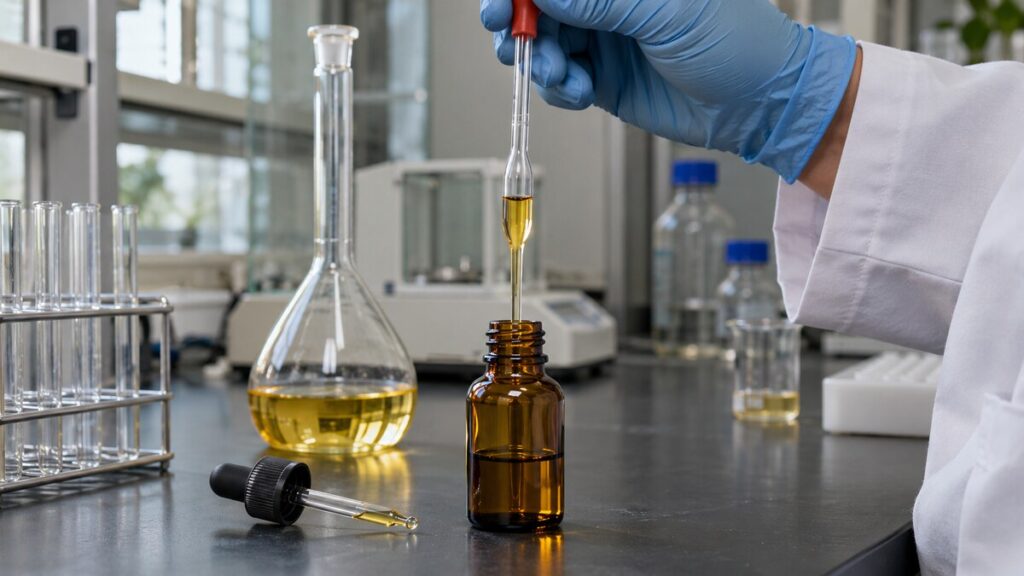
A bottle promises 300 milligrams of CBD. An analysis reports ten milligrams per milliliter. Is the label accurate? The missing piece is the volume. If the bottle contains thirty milliliters, the two numbers describe the same nominal amount. If it contains fifteen, they tell a different story. Before asking whether a chemical assay agrees with the label, someone has to establish what the label actually claims.
An internet order becomes a laboratory sample
In a study of cannabidiol extracts sold online, researchers bought products and measured their cannabinoid contents. Of the 84 products, 26 were within ten percent of the amount of CBD on the label. In 36 samples the measured concentration exceeded the label by more than that margin. In 22 it fell short. The researchers also detected THC in 18 products. Those are findings about products obtained from particular sellers at a particular time. They make the case for independent measurement without turning an online shopping trip into a permanent census of the market.
A product that contains more CBD than stated has an understated label. One that contains less has an overstated label. The language can sound backwards until you specify whether you are talking about the bottle or the printing. A straightforward graph places the measured amount on one axis and the stated amount on the other. Perfect numerical agreement falls on a diagonal, with the direction and size of each discrepancy visible.
Set the rule before seeing the results
Chemical measurements have uncertainty. Treating any departure from exact equality as an error would make almost every real-world label inaccurate. Investigators therefore define a tolerance. The fraction of products classed as accurate depends partly on the width of that band. When a second paper reports a different percentage, check the rule before concluding that suppliers have improved or deteriorated.
The denominator matters too. If one company contributes a dozen products and another contributes one, a product-level count gives the first company more influence. Sampling one bottle of each product captures variety across a catalogue. Buying repeated lots of the same item addresses consistency over time. Both are sensible designs, but a result from one cannot answer the main question of the other. A later investigation of 202 CBD products separated tinctures, gummies, topical products and vape products, making the mix within the sample visible.
What does the laboratory measure?
An analyst removes a portion of the product, prepares it for measurement and compares its chemical signal with reference materials. An oil, a solution and a thick topical preparation present different challenges when trying to obtain a representative portion. The NIST Cannabis Quality Assurance Program examines measurement performance using materials distributed to participating laboratories. Such comparisons help distinguish an uncertain analytical method from genuine variation among products.
A later study of hemp-derived topical products extended label testing to another part of the market. A result for oil intended for one use cannot simply be transferred to a cream in a very different package. Even a precise concentration tells us what is present in the tested material. It does not by itself measure how much reaches a person’s circulation or establishes a clinical effect.
The part of the label that survives retesting
Comparisons become more useful when articles identify the purchase dates, sampling approach, units and accuracy rule. A separate investigation of CBD label claims is worth reading alongside the earlier online survey for just that reason. Agreement or disagreement between papers needs to be traced back to what they tested.
Return to the bottle promising 300 milligrams. With a known volume, a representative sample, a validated assay and an explicit tolerance, a chemist can give that number an honest test. The answer belongs to the actual bottle and the conditions under which it was examined. That may sound modest, but it is considerably more informative than assuming the precision of the printing guarantees the precision of the contents.