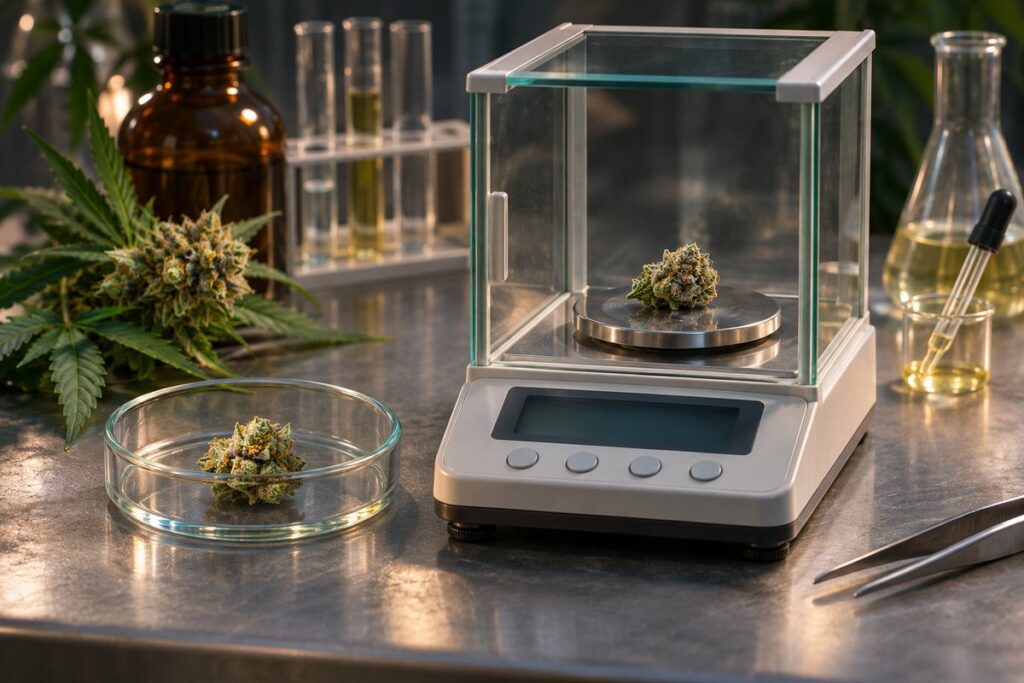
A jar of cannabis flower carries a label of 20 percent total THC. An independent laboratory tests material from the jar and reports 17 percent. How far apart are those numbers? They differ by three percentage points. Measured against the number on the label, the second figure is 15 percent lower. The distinction sounds like bookkeeping until a study uses that exact margin to decide which products were accurately labeled.
What went onto the instrument
A Colorado study of retail cannabis products compared package information with fresh laboratory measurements. Researchers bought products at 52 dispensaries. Their final analysis included 178 flower products and 99 concentrates. They measured cannabinoids and used the mean of three determinations to estimate each product’s potency. Each retail purchase thus contributed a comparison between a declared value and a measurement made on material the investigators actually obtained.
The word “total” matters here. Flower can contain THCA, the acidic precursor to THC, alongside THC itself. The researchers calculated total THC by adding measured THC to 0.877 times measured THCA. The factor accounts for a difference in molecular mass when THCA loses carbon dioxide during conversion. It is a convention for expressing the potential amount on a common chemical basis. A figure produced this way cannot predict how much THC from the jar would reach someone’s bloodstream.
Even the labels took some sorting. Some displayed “THC,” others “Total THC,” and some gave both. Most printed a single number, while a minority printed a range. The researchers spelled out how they handled these cases. Without a consistent rule, two analysts could reach different judgments about the same package before either had so much as opened the lid.
Drawing the boundary around “accurate”
For a single labeled value, the team classified the product as accurately labeled when the observed value fell within 15 percent on either side of the label value. Our hypothetical jar, at 17 percent versus a label of 20, sits exactly on the lower boundary. Had the test returned 16.9 percent, it would land just outside. A small shift at the boundary can change a category with almost no change in chemistry.
Across the study, 56.7 percent of flower products fell within the defined margin, compared with 96 percent of concentrates. Observed potency was generally lower than labeled potency in both groups. Those findings can coexist. Many results can lie a little below the label while staying comfortably inside the allowed band. Reporting the direction of the differences and the fraction within the band reveals more than either result on its own.
What a mismatch can establish
A flower package is a portion of a plant harvest. How well the original testing sample represented the batch, and how well a later sample represented the jar, are distinct questions. Repeat measurements on laboratory material improve confidence in that result. They cannot reconstruct which pieces of the original harvest were submitted for the first test. Evidence that two measurements differ does not identify the person or process responsible.
An earlier Colorado retail flower study also found measured values below package claims in its sample. An investigation of edible products tested a different label promise: milligrams in a food item. Those studies help locate the problem more precisely. Ingredient distribution in a finished food, variation within plant material and results from different laboratories do not all call for the same explanation. The NIST laboratory quality assurance program addresses one piece of the puzzle by comparing measurements made across laboratories.
For the hypothetical jar, the most faithful description fits into a sentence: a sample independently measured at 17 percent fell at the edge of the study’s tolerance for a 20 percent label. That describes a specific observation. The much larger collection of jars and concentrates lets the Colorado investigators ask the more consequential question of how often a shopper could expect the two numbers to agree.